|
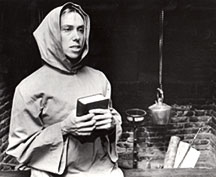
Mary Dyer
Born in England, William and Mary Dyer (c.1611 - 1660), emigrated to Boston in 1635. They became followers of Anne Hutchinson and were drawn into the "antinomian" heresy. Expelled from the Massachuestts Bay Colony by the Puritan elders, the Hutchinson group became the 'first planters' in Rhode Island and had initial contact with the local Narragansett Indians.
When visiting London to secure their land grant charter with Parliament in 1650, Mary became a Quaker. Upon her return to Massachusetts, she was twice expelled; on the third time, she was hanged on Boston Common for being a Quaker. Historians credit her death with establishing the basis for religious freedom subsequently granted in our Bill of Rights to the U.S. Constitution. A statue of her stands in front of the State House in Boston.
Selected Performance Sites:
- Medford Public Library, July '14
- Roger Williams National Memorial, Providence (RI), July '12
- Cambridge Discovery Days, First Church in Cambridge, August '11
- 375th Founding of Providence (RI), Roger Williams National Memorial, July '11
- Smith's Castle Preservation Trust, Wickford (RI), May '05 - June '09
- Worcester Friends Meetinghouse, November '05
- Sandwich (MA) Friends Meetinghouse, June '04
- Roger Williams National Park Site, Providence (RI), May '04
- Watertown Historical Society, March '04
- Roger Williams National Park Site, Providence (RI), May '03
- Discovering Justice Courthouse Program, U.S. Federal Courthouse, Boston, March '03
- Tiverton (RI) Four Corners Arts Center, August '02
- Cambridge Peace Commission, Lesley University, July '02
- American Friends Service Committee (AFSC), Cambridge, June '02
- American Friends Service Committee (AFSC), Boston, November '01
- Pembroke Historical Society, May '00
- Winchester Public Library, May '00
- South Dartmouth (MA) Friends Meeting, July '99
- Cambridge Friends School, May '99
- Plympton Historical Society, April '99
|



